
Market Analysis
Stocks This Week, Nov 23: AI Selloff, PCE
Read Article
Market Analysis
AI-powered insights into global financial markets
 StockCram Editorial9 min read
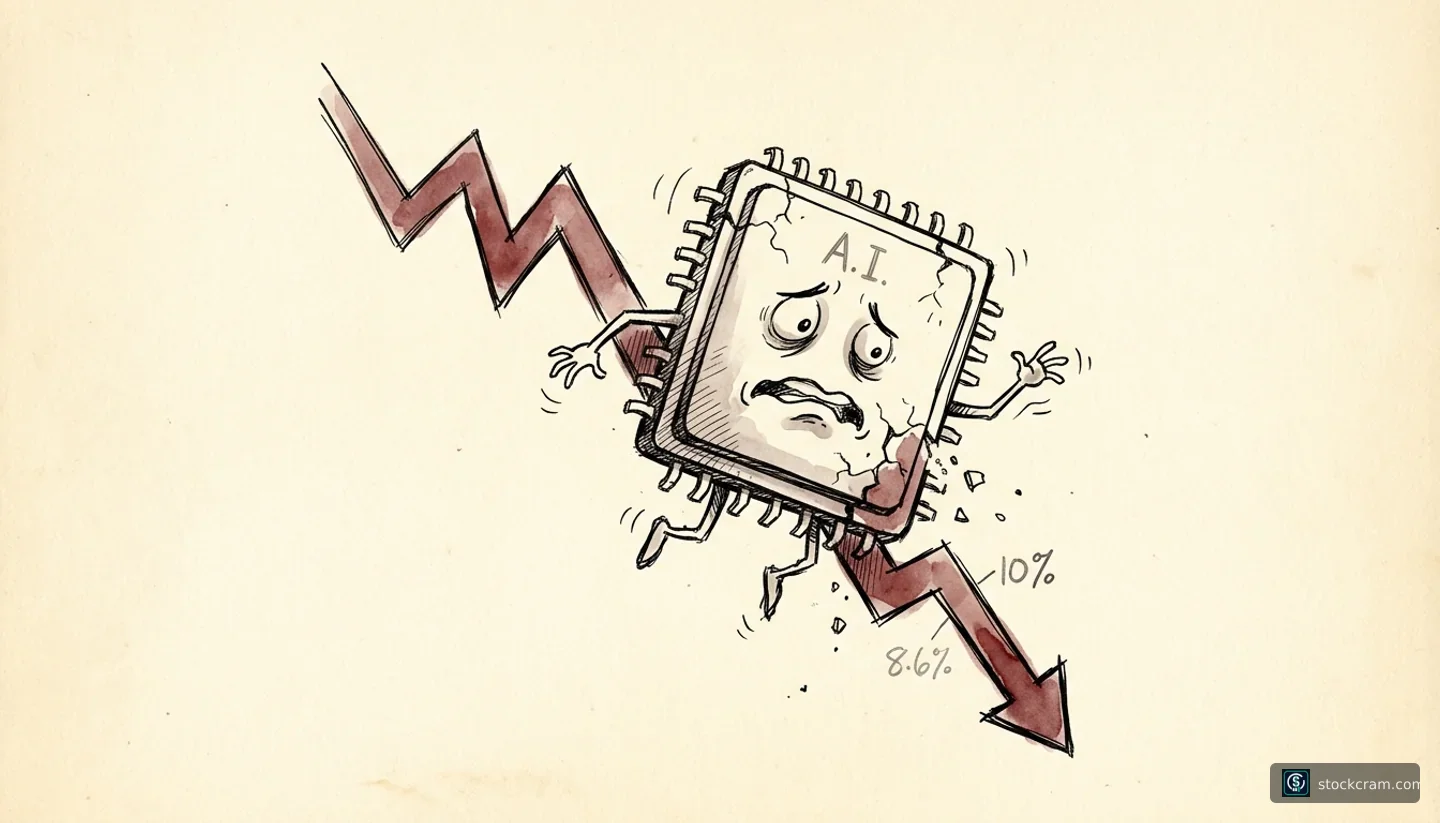
The S&P 500 fell 8.6% in its worst week since April 2025 as an AI-stock selloff, Nvidia's turmoil and Fed rate-hike signals hit together.
Week of Monday, November 16, 2026 - Friday, November 20, 2026
-8.6%
6,910.39
-10.0%
22,617.73
-8.0%
48,147.33
-7.5%
2,581.79
35.89
+86%
4.92%
-0.23 percentage points
$82.46
-7%
$3,525
-8.9%
103.84
Roughly flat for the week; hit a 19-month high on Thursday
Huang resigned as Nvidia CEO, and the Commerce Department moved to tighten China's access to top AI chips. Nvidia then posted record sales, but the stock kept falling. Reuters reported Friday that SEC staff are examining accounting at the company, and an inquiry does not by itself establish wrongdoing.
Chip, memory and AI infrastructure shares fell sharply, and the semiconductor index lost about 17% on the week. Bulls note that Nvidia's sales are still growing fast. Bears point to leadership and governance questions and to doubts about how long AI spending can last.
Minutes from the Fed's October meeting showed almost all officials expect further rate hikes. Some said a larger hike could be needed if inflation data worsen. The minutes also flagged the AI buildout as a source of inflation and financial-stability risk.
Traders priced in a likely December hike. Higher rates can weigh on stocks that are priced for fast growth. Some analysts argue a falling stock market could eventually ease the pressure on the Fed. Others say inflation near 3.6% leaves little room for that.
The 10-year Treasury yield fell as investors bought bonds. Consumer staples were the only sector to rise on Friday. Gold and silver also dropped to their lowest levels in over a year, as a firm dollar, rate-hike expectations and broad position-cutting weighed on them.
The VIX, a gauge of expected market swings, jumped to its highest close since late March. Selling spread across asset types. Some observers read that as a sign investors were raising cash. Others see forced selling that can fade quickly.
Nvidia reported fiscal third-quarter revenue of $115.8 billion, up 103% from a year earlier, in its first report since Huang's exit. Interim CEO Colette Kress leads the company while the board searches for a permanent chief. On Friday, Reuters reported the SEC is looking at possible accounting issues. Shares closed at $125.53.
Nvidia fell 14% Friday and about 23% for the week. It was the stock's seventh straight weekly decline, and it now sits roughly 48% below its October high. AMD and Broadcom also fell sharply on Friday.
Some analysts note revenue and profit margins remain very strong. They also note that an SEC inquiry can close with no action.
Cautious analysts cite the leadership gap and the regulatory scrutiny. They also worry the AI spending boom may be slowing or proving unsustainable.
Anthropic priced shares at $83 and raised about $81 billion in the largest IPO ever. It closed its Thursday debut at $97.17, up 17%.
Shares gave back much of that gain on Friday, falling about 8.5% in the first full session. Chip and AI infrastructure stocks kept falling around it.
Supporters point to the huge demand for the offering as proof that investor interest in AI remains deep.
Skeptics say the pullback shows how fragile sentiment is. They also point to tighter credit and voter support for data center limits in the midterm elections.
The minutes, released Wednesday, showed two officials had favored an immediate quarter-point hike in October. They cited PCE inflation of 3.6% in the year through September, helped by rising energy costs.
The dollar index reached a 19-month high on Thursday. Stocks fell through the week. Long-term yields still ended lower as investors moved toward safer assets.
Some analysts say a clear Fed path removes uncertainty. They also say lower yields could help stocks if the selloff cools inflation worries.
Others warn that higher rates can slow growth, pressure borrowers and hit richly valued shares. Housing is already under strain from mortgage rates near 25-year highs.
It was the smallest weekly loss among the 11 sectors, and it was the only sector to rise on Friday (+0.7%). Defensive groups like this have historically held up better when markets fall.
Steady demand and dividend income drew interest as investors moved away from tech. Utilities still finished the week lower.
Falling Treasury yields helped, but the sector still lost ground in a broad selloff.
Nvidia's turmoil, AI spending doubts and the Anthropic IPO swings drove steep losses across chips, memory and AI infrastructure.
The chip index fell about 10.7% on Friday alone. Concerns about tighter export rules and slower AI spending added to the pressure.
Shares jumped on a report of a possible private-equity buyout. Such reports are not confirmed deals.
The retailer rallied after an earnings report that beat expectations.
Leadership turmoil, an SEC accounting report and AI spending doubts outweighed strong quarterly results.
It fell in sympathy with the wider chip selloff, including a 13% drop on Friday.
Memory stocks plunged as AI infrastructure names sold off.
Shares gave back much of their debut-day gain in the first full session.
Expected: Markets already expected a hawkish tone after hot inflation prints
Traders saw a December hike as near-certain. Higher rates tend to weigh on growth-focused stocks.
Expected: About 197,000
Claims were slightly above forecast but still low. That suggests employers are not cutting many jobs.
Expected: +0.2%
Consumer spending held steady and met forecasts.
Expected: In line with estimates
Sentiment improved but remains low by historical standards.
Data show the S&P 500's 8.6% loss was its worst week since the April 2025 tariff selloff. The Dow's 8% drop was its worst since March 2020, and the Nasdaq's 10% loss was also its worst since then.
History shows corrections of 10% or more happen fairly often, and they have ended in different ways. Some recovered within months, while others grew into longer declines. Past patterns do not predict what comes next. Readers can learn more about managing risk and about market basics.
CEO exit Nov. 12; selloff Nov. 16-20; Reuters accounting report Nov. 20
Jensen Huang's resignation, which followed reports about personal relationships, unsettled investors in one of the world's most valuable companies. The SEC is reportedly examining accounting matters. An SEC inquiry does not establish wrongdoing.
Market Relevance
Nvidia had its worst week since 2008, and AI-linked stocks worldwide fell. Japan's Nikkei and South Korea's Kospi each fell about 5% on Friday, and Taiwan's market had a record weekly loss.
Ongoing. The CEO search and the SEC review are unresolved.
November 16
The Commerce Department moved to close loopholes that let China obtain restricted AI chips. The step came after Huang's departure.
Market Relevance
Mega-cap chip stocks fell on Monday. The semiconductor index lost about 4.6% that day.
Rules and their enforcement may continue to evolve.
November 19-20
Anthropic raised about $81 billion at $83 a share in the largest IPO on record. It rose 17% on day one and fell on day two.
Market Relevance
The offering did not lift the wider AI group. Both days were marked by heavy selling in the Nasdaq.
Early IPO trading is often volatile.
Throughout the week (tanker incidents Nov. 16 and Nov. 19)
Tankers were hit by projectiles and mines near Hormuz. Analysts estimate attacks are running at about one a day in November. Houthi forces also attacked Saudi Arabia's capital.
Market Relevance
Oil still fell for a third straight week. Crude shipments through Hormuz have returned to roughly pre-war levels, and traders expect a supply surplus.
Ongoing. Further attacks could disrupt supply.
November 19-20
Gold fell to about $3,525 an ounce, its lowest since September 2025. Silver also hit a low of more than a year, with futures near $41. A strong dollar, rate-hike expectations and position-cutting drove the drop.
Market Relevance
Gold lost roughly 9% on the week, even as stocks fell. That breaks the usual pattern in which gold holds up during stock selloffs.
Volatility is elevated and could continue.
Disclaimer: This weekly recap is for educational purposes only and does not constitute investment advice. Past performance is not indicative of future results. Always consult with a qualified financial advisor before making investment decisions.